Anyone who studies at Iokai learns what focus does. In Zen meditation, in Do-In and QiGong, in the hands with which you administer a treatment: attention is the material we work with. Yet I experience again and again how far that attention extends when you focus on something very small. A cup barely larger than an egg yolk. A few sips of tea.
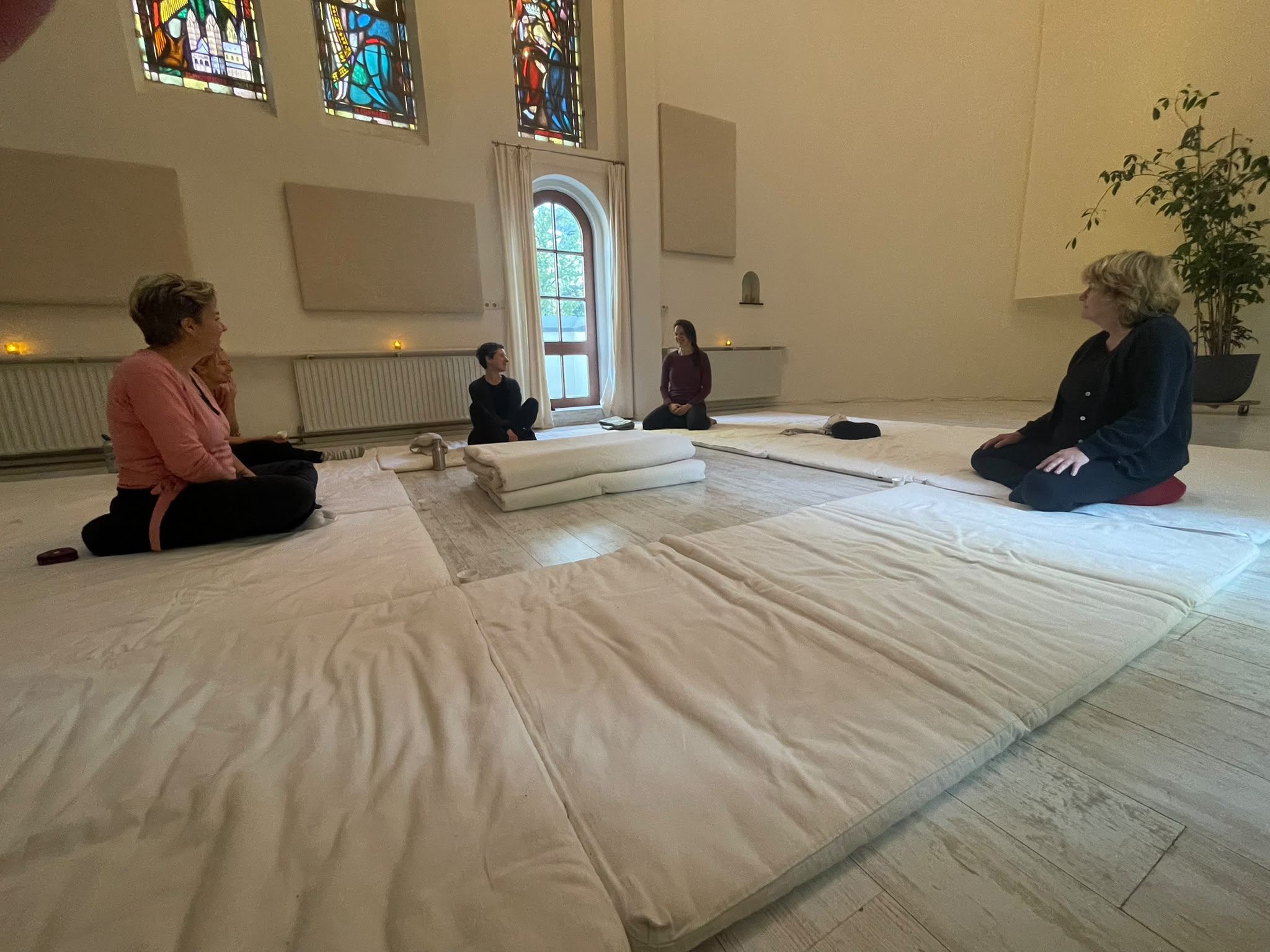
Recently, my student Jiska invited us to a Chinese tea ceremony during the class day in Amersfoort. Here, she tells us herself how she prepares for such a ceremony and what it means to her.
Jiska about the ceremony
Intentions
During my morning walk at sunrise, I feel the coolness of the autumn wind. I breathe in the crisp, clear air and suddenly I know which tea leaves suit the ceremony of today.
A tea ceremony arises from the intention to meet the moment and be here, where I am now. I open the cabinet doors where the different teas are and choose the tea that suits this moment. Each type has its own characteristics and carries a different energy. One is activating and inspiring, another is calm, soothing or grounding.
Silence in motion
The tea leaves and the practice of Chadao, the way of tea, have been an opening for me to listen in silence and feel what is happening in my inner landscape, and in the world around me. Everything is related to each other, changes, is in motion, and comes to rest. This creates space for inspiration. “Silence in motion” is a mantra, or an intention, that arose in me over fifteen years ago while sitting with tea. The tea leaves are a point of anchor for me, day after day, in every season that life brought me. They taught me to remain present in the moment, even when a storm arises. Just then.
Today we are looking at leaves from 2019, from old tea trees in Yunnan, in the far south of China. It is said that the history of tea began there. The people treat the old trees with respect and great reverence. They rarely pick the leaves, so the tree can continue to grow. Life is rich in biodiversity: the trees are covered with moss and are visited by all kinds of insects. Nature feeds itself; the mountains and the earth are rich in minerals. This is how the tea trees grow fully and vigorously, with roots reaching deep into the earth.
Ceremony
I carefully open the crumpled paper in which the pressed tea leaves are stored, and I smell and listen. I feel what the scent is doing to me. This is right now. I gather what is needed: the small tea cups, a handmade teapot made from a specific clay, the water. Carefully I loosen the leaf and place it in the pot.
Before the ceremony begins, we do Do-In exercises with Tanja. She grounds us and makes us aware of the Ki that flows through and around us. One part of this is a partner exercise in which we learn to feel each other’s Ki in the warmth between each other’s hands. We conclude with a Zen meditation.
Jiska
What the ceremony did to me
At that moment, I was sitting there with the cup in my hands. First the explanation, then the smell of the tea tablet, another meditation, and then drinking from that tiny cup with all my attention. It was only about four sips, but the focus on it was so intense that it went deep into my body.
In the flavor, in all those nuances, I could taste and feel the entire history of tea: the tea plant, the land, the earth, the weather conditions over the years. All that Ki became one with me. It gave me so much peace and respect, and a deeper understanding of how life works. That something so simple can bring about so much.
Why does this fit with autumn?
The fact that Jiska began her ceremony with a deep breath of autumn air is fitting for the season. In Eastern medicine, autumn belongs to the Metal Phase, with the Lung and the Large Intestine. The Lung stands for breathing, for taking in fresh air and new impressions. The Large Intestine stands for letting go of what you no longer need. It is the season of change, in which nature withdraws to the essence, and a tea ceremony demands exactly that: breathing, slowing down, and letting go of everything except the cup in front of you. In our blog about the Lung Meridian in autumn, you can read more about that connection.
Focus on one point
What touched me the most this afternoon was what happens when your attention focuses on one point: your world does not become smaller, but larger. In a few sips of tea, I experienced a tree, a mountain, and the weather of many years. I see the same in our classes. When you let your hands rest on someone with full attention, you make contact with the Ki. And in that Ki you feel the life itself, in all its facets: how someone is in their body, what they carry, what flows and what requires attention. Then you are beyond the technique and listen to everything that is there. Therefore, for me, deepening always means going beyond perception.
That is what we want to convey at Iokai Shiatsu: something that you experience yourself and slowly become accustomed to. The beautiful thing is that it comes from our own student group here. Jiska shared what she has experienced and made her own through years of practice, and we were allowed to experience it from the inside. What you learn ultimately isn’t in your hands, but in who you have become.
Tanja van der Schaaf
Can you feel the attention in your hands yourself?
Between November 30 and December 6, new groups of the Shiatsu trial module will start in Amsterdam, Delft, and Amersfoort. In about two months, you will learn to give a complete shiatsu treatment in supine position. Each class begins with Do-In and meditation. You do not have to choose for the entire course right away. For the first eight participants per location, there is a sponsorship contribution of € 250.
