
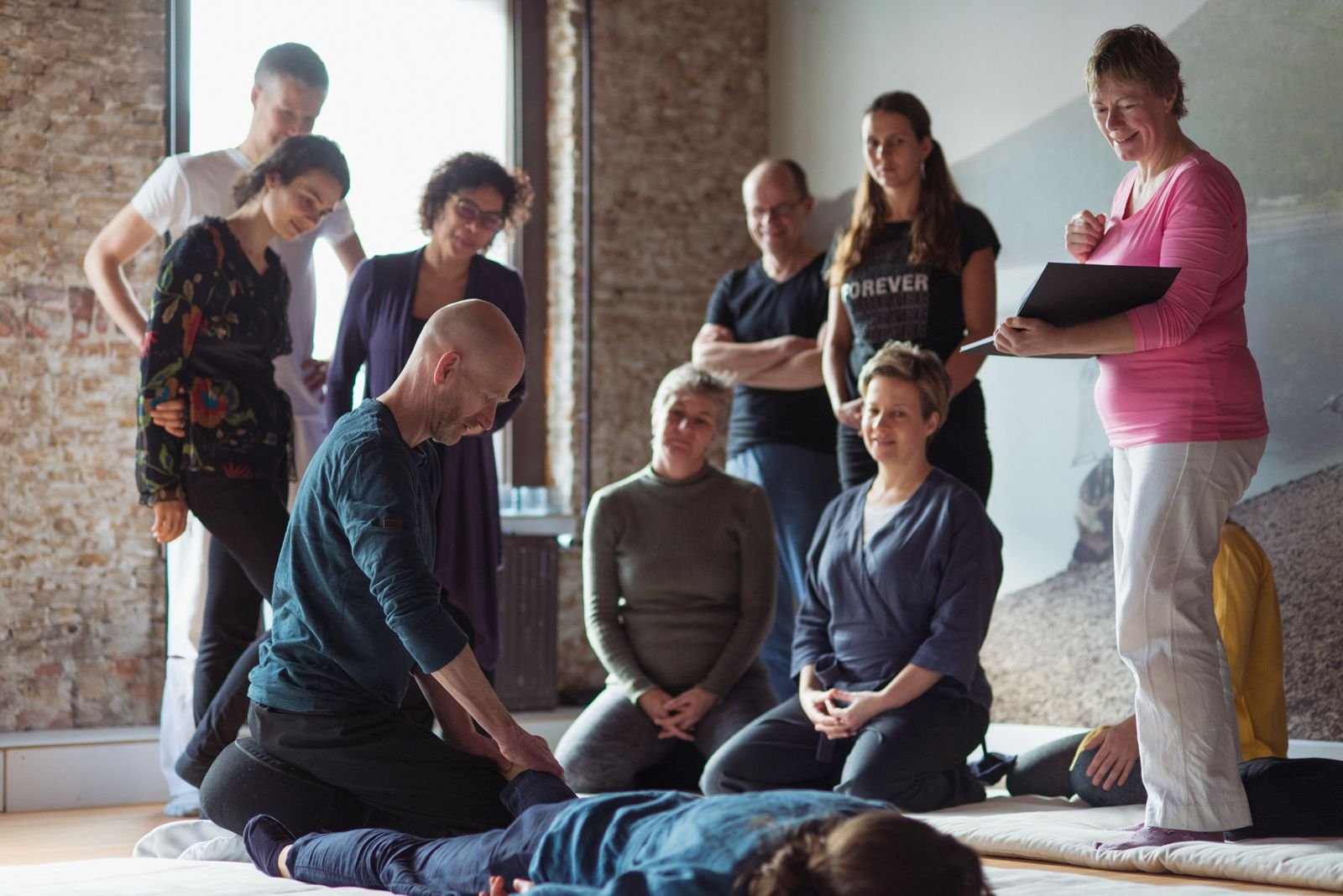
Anyone who receives a shiatsu treatment for the first time is often surprised. The pressure is deep, yet it feels calm. The therapist hardly seems to be exerting any effort. That’s also true: in shiatsu, you work with your body weight. In this blog you’ll learn how that works, why it’s beneficial for the recipient, and what it brings to you as the giver.
Pushing hard feels different than leaning in
If you push with your arms and hands, you tense your shoulders. You press harder too quickly, you get tired and the other person feels that tension too. The receiver’s body then prepares itself.
When leaning in, something different happens. You sit firmly on the ground, your arms are relaxed, and you slowly move your weight forward. The pressure comes from your entire body. Because of this, it is calm and even, and the other person can surrender to it.
How does leaning in work?
- You sit or kneel close to the other person, with a wide and stable base.
- Your hands lie relaxed on the body and distribute your weight.
- The movement comes from your abdomen and pelvis. That’s where your center of gravity lies.
- You lean forward on your exhale and hold the pressure for a few seconds.
- You let go just as slowly as you entered.
The pressure is applied directly to the body. This ensures that it penetrates deep into the tissue without squeezing or pushing anything.
Two hands: one that listens and one that works
In the Zen Shiatsu of Masunaga, from which Iokai originates, you work with two hands simultaneously. One hand remains still and provides support. The other moves over the body and exerts pressure. This way there is always contact and you feel with the resting hand how the other person reacts.
What the recipient notices
Because the pressure is calm and predictable, the body can let go. Many people notice that their breathing becomes deeper and that tension in their shoulders or back eases. The treatment feels deep and at the same time gentle.
What it brings to you as a giver
Working with your own weight is also good for you. You save your wrists, fingers and shoulders because they don’t have to do the work. This way, you can give a whole treatment without getting tired. And because you stay relaxed yourself, you’ll feel better about what’s happening under your hands.
That’s why we start the lesson with Do-In: exercises to free your own body and bring your attention to your belly. Those who are relaxed themselves can pass on the relaxation.
You learn it faster than you think
Relaxing sounds simple and that is exactly what it is once you feel it. Josée wrote after the Intensive: "After just 3 sessions, I was able to give a full shiatsu massage for the back of the body (in a supine position)."
In the trial module In two months you learn the basics: how to sit, how to lean in and how to work with two hands. After that, you decide whether you want to continue. The next groups start on November 30 in Amsterdam, December 1 in Delft and December 6 in Amersfoort.
Feel for yourself how it works
Reading about how to lie down is one thing. Feeling it is something completely different. On an open evening, we will do Do-In together, show you what a shiatsu treatment looks like, and there will be time for all your questions. You don’t need any experience.
- November 19, Delft, 19:00 to 21:30
- November 21st, Amersfoort, 14:00 to 16:30
Frequently asked questions
Do you need strength to give shiatsu?
No. You work with your body weight, so even if you have a small or light build, you still apply deep pressure.
Does shiatsu hurt?
The pressure is deep and yet calm. You always decide what is comfortable yourself, and the therapist adjusts the pressure accordingly.
Why do you lie on a mat on the floor during a shiatsu session?
On the floor, the therapist can sit stably and lean over you. On a high table, this is less easy to achieve.
Can I learn shiatsu without any experience?
Yes. In the trial module you start from the basics. You don't need to know anything beforehand.