
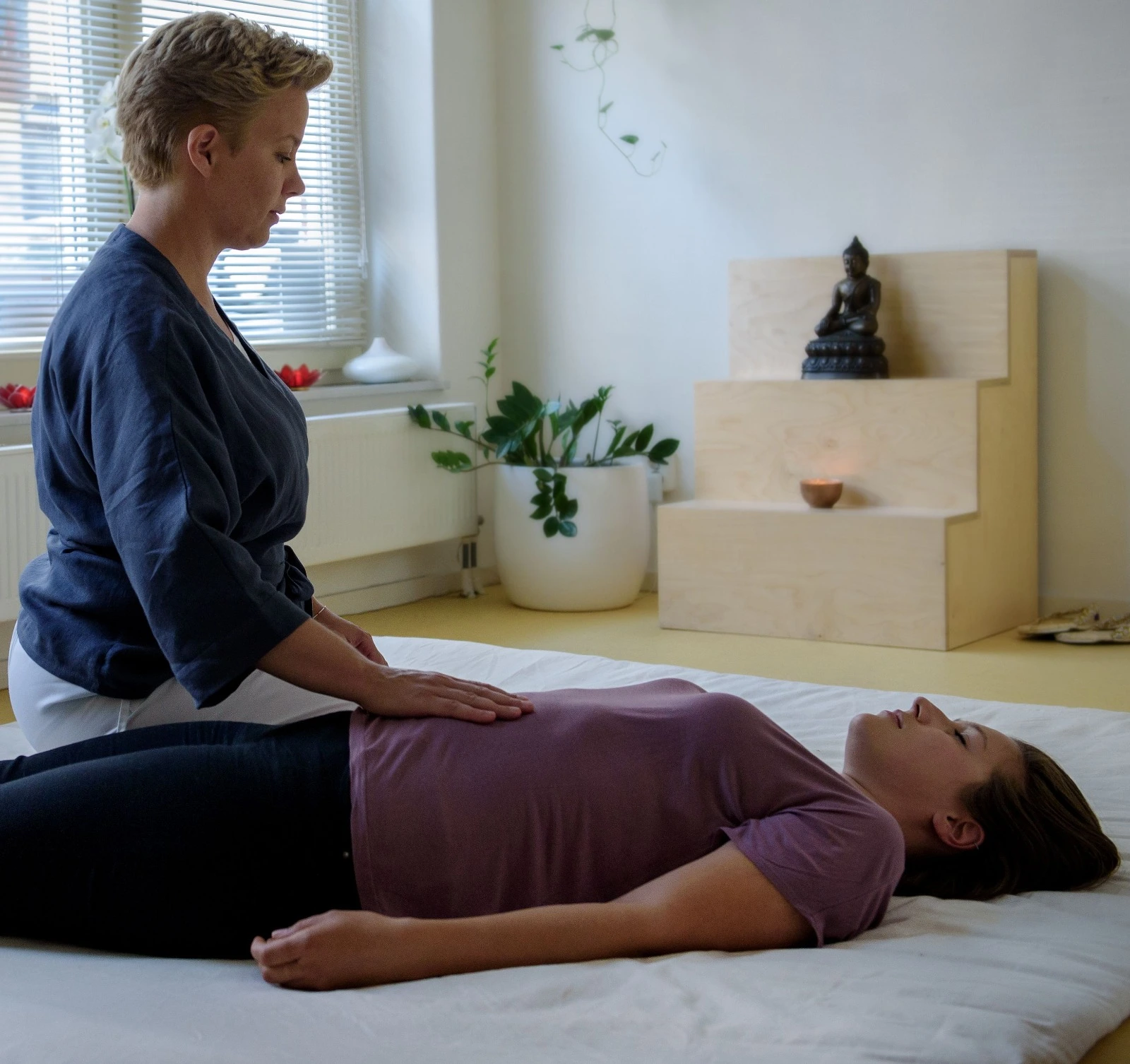
Shiatsu, an encounter in touch
About the ability of the hands to listen and the power of true presence.
Shiatsu is an encounter in stillness and attention, which begins even before the first touch takes place. Often, Shiatsu is directly associated with massage. Although touch is an essential part, that designation does not do justice to the full depth of this method of working. Shiatsu goes beyond applying techniques to the body. It is a wordless conversation, in which the hands align with what is being revealed from within.
Literally, Shiatsu means finger pressure. Yet it is not pressure imposed, but a movement that arises in interaction. When I apply pressure, I feel in the tissue how much space is available to deepen the contact. Of course, there is the conscious choice to step into the treatment area and take a seat on the mat. But as soon as the hands meet, that arrangement shifts to the background and a form of contact unfolds that is detached from thought.
Within the Shiatsu approach, we do not work on a body, but harmonize with the whole. The contact moves on multiple levels simultaneously: physical, emotional, energetic, and spiritual. It requires a refined listening, in which the hands follow the movement of Ki, the life energy, in the entire system of the human being.
Not a tool, but observation
The unique nature of Shiatsu becomes clear when we compare it with acupuncture. Both traditions work with meridians and pressure points, but the approach differs fundamentally.
An acupuncture needle is focused and deliberate. It is used to achieve a specific effect and goes directly through the skin. In Shiatsu, the hand is not an instrument, but a sense organ. Where a needle crosses a boundary, the hand remains present until space is created from within. The hand possesses a quality that a needle hardly knows: the ability to wait.
Waiting for the invitation
To clarify this principle of energy mindfulness, I often use the image of a visit with a cup of tea in my classes. When you arrive at someone’s place, you don’t just walk in. You knock on the door.
That first contact with the meridian is the first sign of welcome. You feel that you are welcome, that there is space to continue. Only after that invitation do you step inside. You take in the surroundings, experience the atmosphere, and share the moment together. There is attention and reciprocity. When the visit is over, you say goodbye. You leave the space as you found it, with respect, and at the same time carry away something of the encounter that took place.
Listening from the middle
This listening with the hands has its origins in the Hara, the energy center in the lower abdomen. For me, the Hara is the starting point from which I work. It is a place of peace, presence, and inner stability. From that silence, contact can be established with the core of the other, an encounter from center to center that unfolds in non-action.
In this contact, the Hara functions as a mirror. It reflects what is really alive in the person receiving it at that moment. By not wanting to change or direct anything, but simply remaining present to what is shown, a sense of welcome naturally arises. In this safe space, where the first contact forms the beginning and not the goal, the movement is given the freedom to emerge from within.
The bed of attention
In this interplay of closeness and careful touch, a space is created where one truly feels seen. It is this refined harmony that touches upon the deeper layers of our existence. It reminds us that healing does not come from forcing change, but from patiently being present. It involves waiting patiently and gently inviting others to enter that space together.