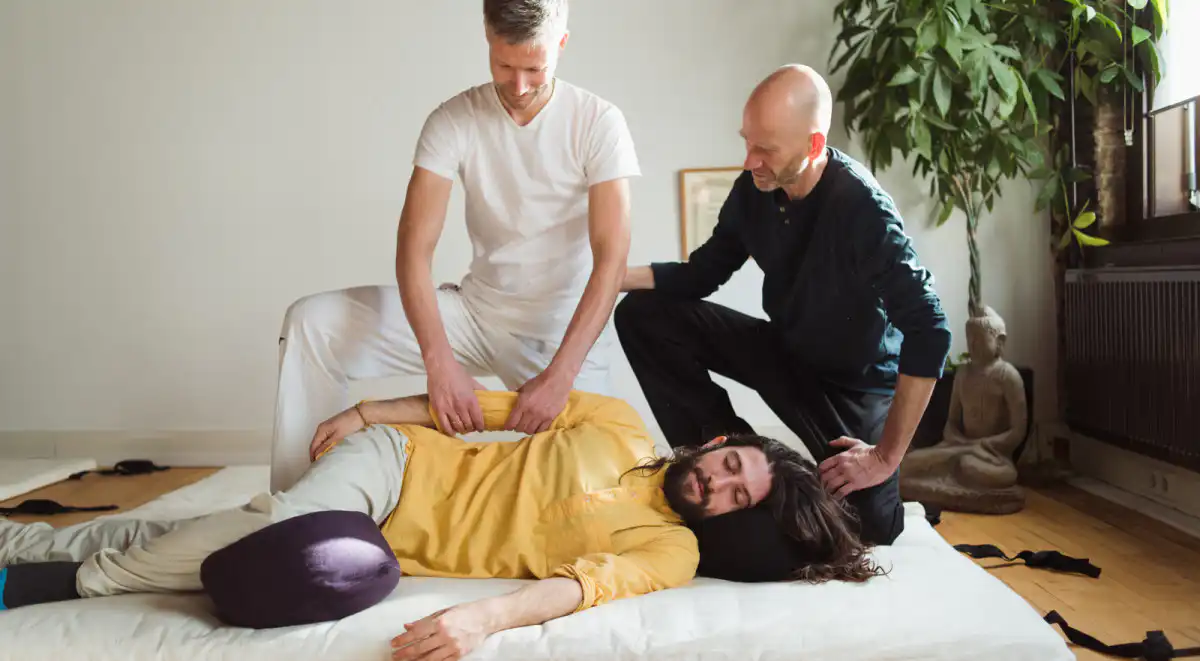
In the third year of the training, we focus on making a diagnosis in the traditional Eastern way and performing an appropriate treatment. Already in the first and second year of the training, without placing too much emphasis, you learn a certain foundation in the Eastern way of making diagnoses. It is a way that is different from what we are accustomed to in conventional Western healthcare.
First of all, it is important to realize that as Shiatsu therapists we do not make diagnoses like those made in conventional healthcare. Such a diagnosis is reserved for a qualified practitioner and is set out in the law. When we talk about making a diagnosis, we mean forming an image of what is going on with a client so that we can adapt our treatment strategy accordingly. In this context, it is not just about the complaints that someone brings up; it is about the person behind the complaints—the real, deeper cause of the problems. This requires not only an understanding of what illness is and what health is, but also an unbiased view without judgment and without prejudice.
The symptoms or complaints that clients bring to a shiatsu therapist are very diverse. They range from physical complaints such as low back pain, neck and shoulder pain, to chronic complaints to emotional and mental problems. These symptoms we see are an expression of a person’s Ki (life energy). Just as one’s health is an expression of Ki, so too is Ki. For us in our Western society, Ki is often a difficult concept to understand. You can think of it as a collection of our life functions. We breathe, we move, we digest food, we have thoughts and emotions. These are all functions of our being as human beings. We call these functions Ki in Japanese. In traditional Chinese medicine, this is called Qi. You cannot see a function. You cannot see Ki. However, you can see its manifestation. You can see how someone moves or what emotions someone has. Compare it to the app software on your smartphone. You can't see that, but you can see the manifestation of it in the form of sound, images, etc.
When we make a diagnosis in traditional Eastern medicine, we do this by looking at the manifestations of Ki. What does that manifestation look like? We use several diagnostic methods for this.
- Watch Bo Shin
- Bun Shin Listening and smelling
- Mon Shin Ask questions and obtain information
- Setsu Shin Voelen (cardiac diagnosis, back diagnosis, pulse diagnosis and meridian diagnosis)
By observing, listening, asking questions, and feeling, we get an idea of how the Ki manifests itself. We see and feel the physical expression of the Ki and try to understand where the Ki suffers. In other words, where the Ki can no longer adapt to what is being asked of it.
A good diagnosis is characterized by looking at the person who comes to us for treatment without prejudice or bias. Due to the way we are raised and educated in our Western society, we want to work towards a solution as quickly and effectively as possible. We want to focus so intently on removing our clients’ complaints that we often fail to see the bigger picture or the deeper cause. By being unclouded by our own experiences, we gain a truly accurate picture of the person who comes to us for treatment. An image that is not colored by our own experiences, opinions, preconceptions, or disapproval. This aspect is the most difficult to grasp and apply as a new Shiatsu therapist. It is a process that we learn to master over the course of our training. A process that continues after our training. It not only makes us a better shiatsu therapist, but also ensures that we develop as individuals.
The diagnosis we make therefore concerns the person behind the symptoms. What makes this person develop these symptoms? What is actually happening on a deeper level? Our treatment focuses on improving these conditions. In doing so, we ensure that we We are not aiming to make the client better, but we are merely helping the client to allow their own Ki to circulate more effectively. The client will then be able to improve again on their own. Often this involves an understanding of the life circumstances or lifestyle that may have contributed to the onset of the illness. This ultimately enables someone to truly improve and not become ill again. Recognizing the illness and supporting the client in recovering and maintaining their health is the true goal of our Iokai Shiatsu therapists.