
It’s no secret that we’ve been publishing a new blog since recently. Here, you’ll regularly find interesting articles, interviews, videos, and even e-books. I’ve also been given a dedicated section on the blog: a column where I write about what interests me as a teacher and head of the program.
There is a subject that has been very moving to me lately: the way of thinking behind the original Eastern medicine that is so different from our way of thinking in Western society. During my own study of Shiatshu, now 23 years ago, I was drawn time and again by the depth and wisdom of one of our teachers: Sasaki Sensei. What he said hit home. I knew he was reaching a deeper level of understanding, but I couldn’t reproduce it, let alone understand it. Only now am I beginning to understand why that is and what value it has for us as Shiatsu therapists.
In our Western society, we refer everything we perceive to a truth. A truth that can be physical, religious, or otherwise. Everything we see we reflect back to this truth. Therefore, we think that something is good or bad, healthy or sick, weak or strong. The way of thinking behind the original Eastern medicine is different. It is contemplative and sees only what is. Without judgment, you look at what is and how it relates to other things. This is so fundamentally different that it is almost impossible for us to comprehend. Something is! Nothing more than that. If you truly can grasp that, this brings a whole different approach. Your understanding of illness and health and your treatment as a Shiatsu therapist gain more depth. You can see a person as they are.
One aspect that is directly related to this is the way in which the texts on Eastern medicine are written. Not a rigid Western language, but a writing that uses visual representations. A kind of visual representation of what one wants to express. You can imagine that this describes something quite differently than language. It leaves room for interpretation of the meaning. Or as Sasaki Sensei so beautifully puts it: ‘space for deep thinking’.
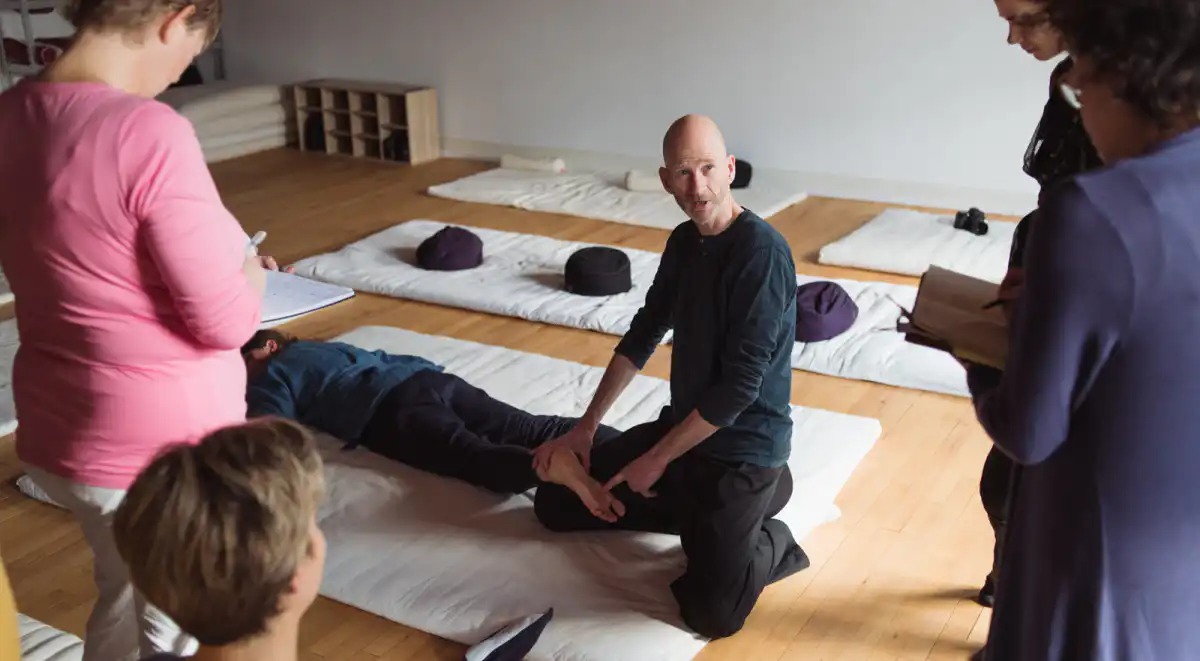
During our training, we sit on meditation cushions. In Japanese, we call it a ‘Zafu’. To clarify the difference between the Eastern way of thinking and ours, I ask one of the students to describe what they are sitting on. The first reaction is often “A Zafu!” or “Kissen”. When I wait and sometimes wait even longer, the answer comes. Then they describe it: “It’s something I’m sitting on, it’s soft and dark red in color. It gives off a vibration when I move forward; it’s a separation between me and the ground; it supports my sitting bones, it makes me able to sit upright”, etc., etc. After this example, some students get it. It is a completely different description than we are used to. You describe what you observe and what is there. Not a word you have learned to use, but looking and perceiving from within yourself.
Another striking example was during the recent teacher training we had with our European colleagues. One of my Dutch colleagues stood in front of the group to explain what a side is. We were working on the explanation of the functions of the Glabella Meridiaan. A meridiaan that runs for the most part on the side of the body. She stood there for about half an hour and expressed all sorts of thoughts that came to her mind. “You have a side as a connection between front and back”. “A side makes you able to move left and right”. In the end, the most important aspect came to the surface; “a side makes you able to look from the center to the left and to the right and to see what is there”.
Or, one important function of the Galactomammary gland is that from the center you can see what is happening. And from there you can make decisions. By ‘center’ we do not only mean the physical center but our center as human beings. From this center, we can see what is happening without judgment or thoughts. As you penetrate the depth of this function, it is a function that is essential to us as human beings. During the instructor training, it became clear to me how different and deeper the function of the Galactomammary gland is than what is often described in Western books as “making decisions.”.
The Iokai Shiatsu Professional Training is a practical course. We explain the theory using the Eastern way of thinking. The above is a beautiful illustration of that.