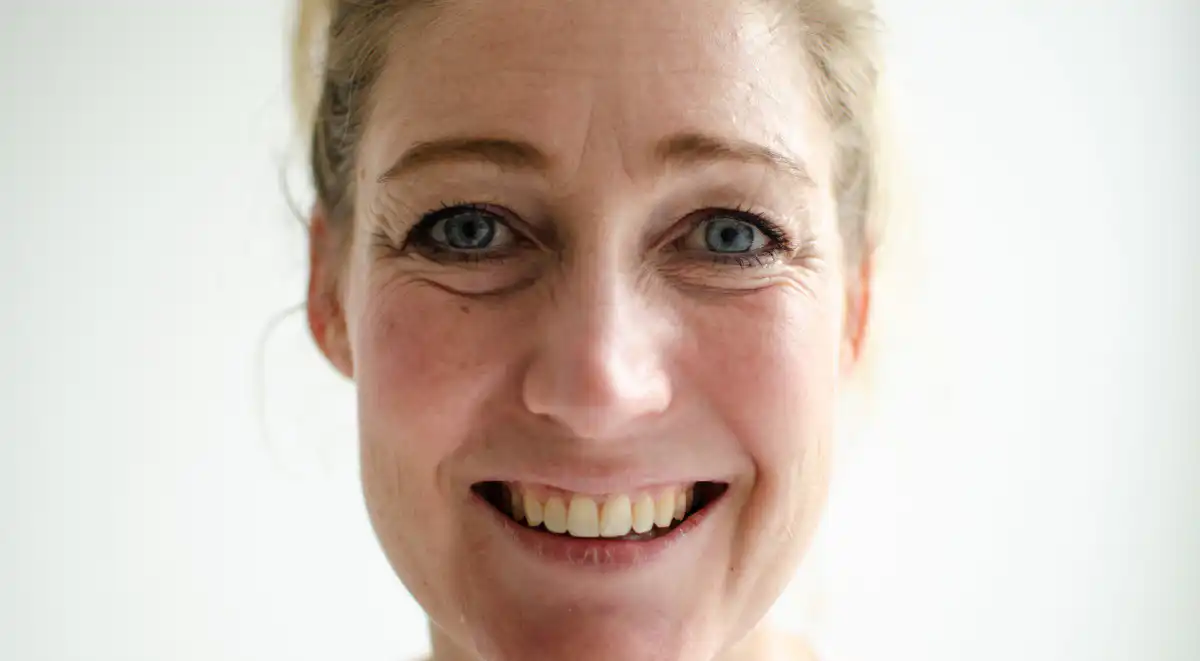
Putting the other person in their power is perhaps the most important thing Shiatsu therapist Mieke van den Berg learned during her training. “Your client is not a patient. You put someone in their power to be able to do it themselves.”
Imagine yourself. Who are you, and what do you do in your daily life?
“I am Mieke, the mother of a blended family with three daughters. I am driven by the power of people and organizations. I worked for a long time as an organizational consultant for the education sector, and now I work as a program manager at a training agency. I develop training programs for school leaders, school administrators, and teachers. By making education and teachers stronger, we make the students stronger. That is ultimately the goal.”
Why did you choose Iokai Shiatsu?
“I find the combination of working with my head and my body to be nice. But I didn’t want to be a teacher for the group anymore; I wanted to be a student. It was time for something new.”
But then you could have also done a Pilates training. Why this choice?
“Since 2008, I have regularly visited a shiatsu masseur myself. For me, that was the ultimate combination of being busy with my head and feeling my body. At a certain point, my masseur invited me to a seminar on Ameland to further explore shiatsu. I was immediately drawn to doing it myself. I started looking for a school that matched my own ambitions and that had a click with the language and way of communication. I also found it important that not only women participated, but that the groups were mixed. I found that combination at the . Iokai Shiatsu Professional Training”
How did you experience the training at that time?
“I found what I was looking for. There are men and women, people I feel at home with. We had nice conversations, also about things other than just shiatsu. The teachers also reflected this beautifully: Working with your head and your body go very well together.”
Is there a big difference between the first and second year?
“Definitely! In the first year I was very lost. How do I get my head and body together? I couldn’t really feel anything. I was very high in my voice and my breathing, and I often ran so hard that I literally couldn’t feel any emotion anymore; I was a bit ‘dead’. Now I am much more aware of myself. I have really come closer to myself. My body and my feelings have become much stronger. My hara has strengthened and has become much more of a anchor. In the second year, there really was a dimension added. I can also feel more in my hands. That makes me curious about what else there is to discover.”
How do you experience shiatsu yourself?
“It calms me down a lot when I treat people. I work very much on the breath and take over the rhythm of my client’s breathing. Sometimes my teachers do tell me that I need to work a little faster, ha ha. I work very concentratively and don’t want to rush things, but feel things. My sports classes were always based on dance music. With shiatsu I also feel like I’m dancing. We do it together. In a treatment, you also do it together. You can’t just transmit. It’s not a matter of above versus below, therapist or patient: it’s a collaboration. You’re complementary to each other.”
The concept of Ki, what does this mean to you?
‘Everything is Ki’, would Lex, the lecturer at the course, say. For me, ‘Ki’ is something I feel, but my head still can’t put words to it. That’s where the wonder lies. My body feels it, my head still can’t put words to it. The concept of ‘Ki’ has gained me a lot more depth since a seminar with Kazunori Sasaki. He explained it as follows: Ki and meridians are a concept. You don’t have to prove it. It’s like with the numbers 0 and 1. Science is still busy defining these concepts, but that doesn’t mean you can’t work with 0 and 1! I found that very liberating: My head doesn’t have to understand this, I don’t have to put words to it to be able to work with it. I can accept that it’s something I feel and experience, and that I can let others feel it too.”
Can you tell us a little more about the seminar?
“It was my first seminar with Sasaki. I found it very inspiring. During the seminar, he did an exercise that also involved Ki. He asked you to extend your arms to the side and raise your thumb. Another person had to bend your arm instead. And it worked. Then he asked you not to extend your thumb but your pinky. And it didn’t work to bend the arm! A huge eye-opener for me. I’m a hard worker and I get really focused on something. Through the exercise I discovered: if I approach it differently, it can be more effective and with much less effort. Your pinky is the line of your heart (inside), the thumb is connected to your lungs (outside). In contact with the outside, it’s much harder to be in your power, to stand on your own. I experience that myself. I tend to be more casual and can lose myself by being too focused on the other person. That costs a lot of energy and you don’t always achieve what you want.”
What do you want to convey to others?
“What I find incredibly great about the training is that it is twofold. You come out of it incredibly strong because you are much more centered and able to put another person in their power. Not to help someone, or to take care of someone, but to really put someone in their power. ‘It is what it is, and it takes care of itself’, Rini always said in the first year. You are not helping someone. Your client is not a patient. You are putting someone in their power to be able to do it themselves. This is the same as with children: you nurture them not to keep them with you, but to put them in their power, to ensure that they can do it themselves. In my work, I have the same goal: at some point I have to become superfluous. With your hands you can achieve a lot, and especially independence. That is for me the ultimate goal of Iokai Shiatsu!”